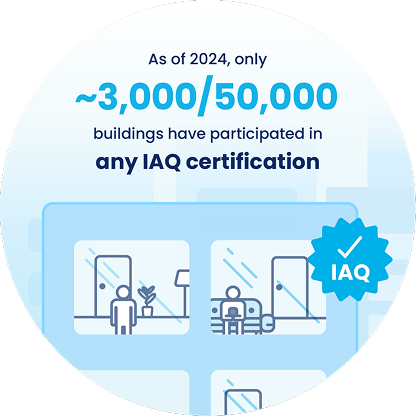
Participation in IAQ certification is voluntary and is not adequate to address the public health impacts of poor indoor air quality on the population. As of 2024, only around 3,000 of 50,000 buildings have participated in any IAQ certification.
Recent research has also suggested the greatest inhalation cancer risk has shifted from Particulate Matter to Volatile Organic Compounds, which are generally believed to mostly come from indoor pollutants.
Furthermore, the public and policymakers do not recognise the significance of IAQ issues, especially on health implications for vulnerable groups. Despite the fact that private, education, social welfare and health institutions serve large numbers of space users and many of them are sensitive groups to air pollution, venue operators neglect or are unaware of the need for IAQ monitoring, ventilation and maintenance of control measures.

In the long term, we hope to;
To achieve this CAN’s focus on the issue of IAQ is targeted towards the following areas;

Gathering knowledge via collaboration with academia

Building connections with partner networks

Communication with key stakeholders and influencers to influence environment and health policy

Raising public awareness to put the issue on the social agenda

Continuing to advocate for change in environmental and health policy in the area of Clean Air
A series of 5 study components is proposed which incorporates a multi-faceted research approaches, including literature reviews, observational data collection and analysis, review of existing solutions, comparative studies, and surveys, to profile the work and experience to date by overseas and local academics, government, public and private institutions on IAQ.
The study components will cover;

Correlation between IAQ and health

Institutional practices and market solutions for IAQ

Mapping air quality data in publicly accessible locations

Review international laws on IAQ to identify best practices and policy gaps in Hong Kong

Ongoing Studies

Branding of the IAQ initiative to create compelling narratives that enhances awareness and motivates action, builds public awareness

Capacity building including consolidation and sharing of knowledge, expertise, and other resources

Development of mutually beneficial partnerships that align goals across sectors and institutions
Study Component III will share information on the common needs and challenges across various sectors and institutions and identify the information, support or incentives required to address the gaps.
This study component aims to consolidate international and local researches on the correlation between indoor air quality (IAQ) and health and safety outcomes.
Based on our existing knowledge, there is an extensive study to show the correlation between IAQ and health and safety. This study component aims to build a stronger case locally through profiling the existing study findings which are relevant to context to HK.
The study component will identify potential at-risk occupations, indoor spaces, and communities most affected by poor IAQ, providing insights for potential preventive or mitigative strategies.
The study component will identify potential at-risk occupations, indoor spaces, and communities most affected by poor IAQ, providing insights for potential preventive or mitigative strategies.
The study component aims to provide the knowledge foundation to build awareness and pave the way for further collaboration among stakeholders and policymakers.
This study component aims to initiate constructive dialogues with the operators of
selected publicly accessible locations and the overall policymakers on IAQ issue,
including the various Government departments – Environmental Protection
Department (EPD), Leisure and Cultural Services Department (LCSD), Electrical and Mechanical Services Department (EMSD), etc.
accessible locations through case study, we aim to share knowledge among the target audiences on IAQ management.
Throughout the process, we also aim to amplify public and other sectors’ understanding of the status of IAQ management in Hong Kong.
This study component aims to identify common needs and challenges associated with implementing IAQ management practices across different sectors and institutions in Hong Kong.
It aims to identify opportunities for addressing gaps in IAQ management and serve as a basis for formulating policy recommendations to improve IAQ management in Hong Kong.
This study component aims to map categories of solutions and identify specific solutions for the three key aspects of IAQ management – monitoring, reporting, and improvement and their application across various sectors.
The study component aims to identify the range of legislation and practices in various comparable jurisdictions, and the journey for establishing such frameworks.
Through showcasing the importance and feasibility of regulatory frameworks which establish mandatory IAQ standard and require IAQ monitoring and reporting in specific locations, the study also aims to initiate discussion on the implications to Hong Kong.
Initiatives
Our IAQ campaign is based on the idea of 'The 90%', where people spend close to 90% of their time indoors and how much the air they breath all the time affects them.



Initiatives